
The The Impact of Artificial Intelligence on High-Quality Development of Manufacturing Enterprises: A Cross-Disciplinary Perspective on Management and Technology
##plugins.themes.bootstrap3.article.sidebar##
##plugins.themes.bootstrap3.article.main##
Abstract
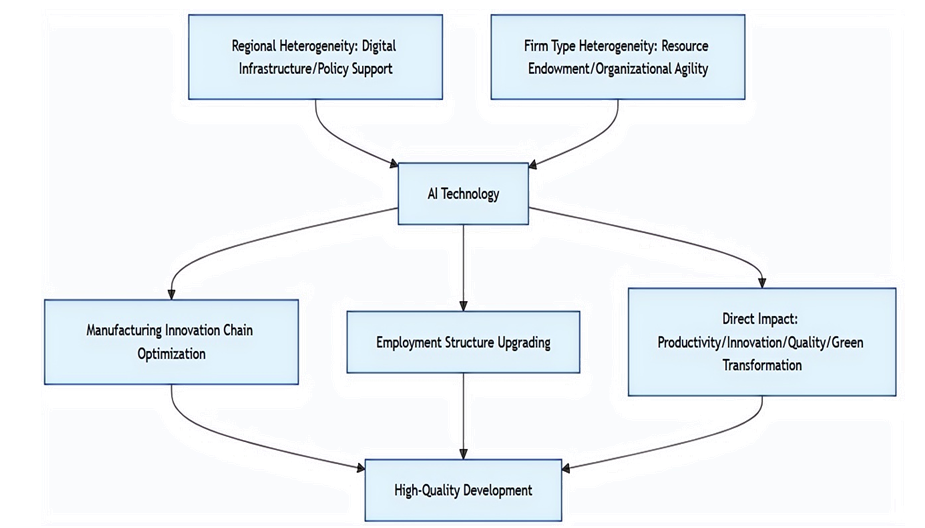
This paper conducts a thorough investigation into the influence mechanism of artificial intelligence (AI) technology on the high-quality development of manufacturing enterprises, integrating theories from management science, operations research, and industrial economics. Empirical analysis based on data from 2008 to 2022 of Chinese A-share listed manufacturing companies indicates that AI technology exerts a direct impact on enhancing productivity, innovation capacity, product quality, and green transformation in enterprises. Moreover, it functions as an indirect catalyst through two mediating mechanisms: (1) the optimization of the manufacturing innovation chain, rooted in resource allocation theory; and (2) the upgrading of employment structure, informed by human capital management theory. The study also reveals significant regional heterogeneity (moderated by digital infrastructure and policy support) and enterprise-type heterogeneity (differentiated by resource endowment and organizational agility). Specific data show that the eastern region’s AI-driven TFP growth is 0.0472 (p<0.01), significantly higher than the central region’s 0.0321 (p<0.01) and the western region’s 0.0018 (p<0.01). State-owned enterprises (SOEs) exhibit an AI impact coefficient of 0.0322 (p<0.01), while non-SOEs reach 0.0592 (p<0.01), reflecting distinct advantages. These findings contribute to management theory by integrating technological innovation with organizational development frameworks and provide practical, region- and enterprise-specific policy implications.