
Association of Life’s Crucial 9 with All-Cause Mortality in U.S. Adults with Hypertension: A Nonlinear Dose-Response Analysis from NHANES 2005–2018
##plugins.themes.bootstrap3.article.sidebar##
##plugins.themes.bootstrap3.article.main##
Abstract
Abstract
Background:
Life’s Essential 8 (LE8) defines ideal cardiovascular health (CVH) by four behaviors and four factors; Life’s Crucial 9 (LC9) expands LE8 by including psychological health, such as depression. Although higher CVH is linked to reduced mortality, this association may be nonlinear in hypertensive adults. We investigated the relationship between LC9 and all-cause mortality in U.S. adults with hypertension, hypothesizing an inverse, nonlinear association.
Methods:
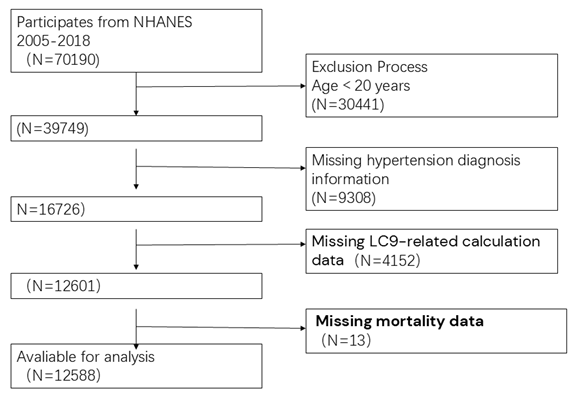
We analyzed 12,588 hypertensive adults (age ≥20) from NHANES 2005–2018. Cox proportional hazards models estimated hazard ratios (HRs) for all-cause mortality. Nonlinearity was evaluated by generalized additive models and two-piecewise Cox models.
Results:
Participants’ mean age was 59.8±14.8 years; 50.9% were female. Over a mean 7.1-year follow-up, 2,220 deaths (17.6%) occurred. Higher LC9 scores were significantly associated with lower all-cause mortality. In fully adjusted models, those in the highest LC9 tertile had a 31% lower mortality risk than the lowest (adjusted HR 0.69, 95% CI 0.59–0.81, P<0.001). A nonlinear dose-response association was observed. Two-piecewise Cox models identified an inflection at LC9 = 39.4. Below this, each 1-SD increase in LC9 was linked to a 34% lower hazard (HR 0.66, 95% CI 0.51–0.85). For LC9 ≥39.4, each 1-SD increase corresponded to a 12% risk reduction (HR 0.88, 95% CI 0.83–0.94).
Conclusions:
Higher LC9 scores are associated with lower all-cause mortality in hypertensive U.S. adults, with a nonlinear relationship and diminishing returns at higher scores. Achieving a CVH threshold may benefit this population.
Keywords: Life’s Essential 8; Life’s Crucial 9; cardiovascular health; hypertension; mortality; nonlinearity; Cox model.